Toxic femininity gets tossed around a lot, usually without care. Let’s be precise. The term points to the internalization of misogynistic rules about how women should behave: be pleasing, be quiet, be small, serve first, apologize. It is not an attack on softness or care. It is what happens when patriarchal demands bend feminine expression into a cage.
If you want freedom, you do not scold yourself for “doing femininity wrong.” You study the cage and start loosening its bolts. Name the rules, disarm them, offer yourself alternatives, and practice new moves until your nervous system learns that power and care can share the same body.
Start Here: Naming the Invisible Rules
Begin by surfacing the quiet scripts that have shaped you.
- What is one expectation you have felt about “how a woman should behave,” “that’s not lady like,” or “who does she think she is?” – something that operates like an invisible rule?
- Where did you first absorb it: family, school, church, media, work?
- Recall a moment you were shamed or silenced for anger, ambition, success, or assertiveness. What story did you tell yourself afterward?
- Where do you slip into “nice girl mode” in conflict or negotiation: softening your tone, minimizing, laughing it off?
People often discover that their “private quirk” is a shared pattern. That realization turns isolation into information.
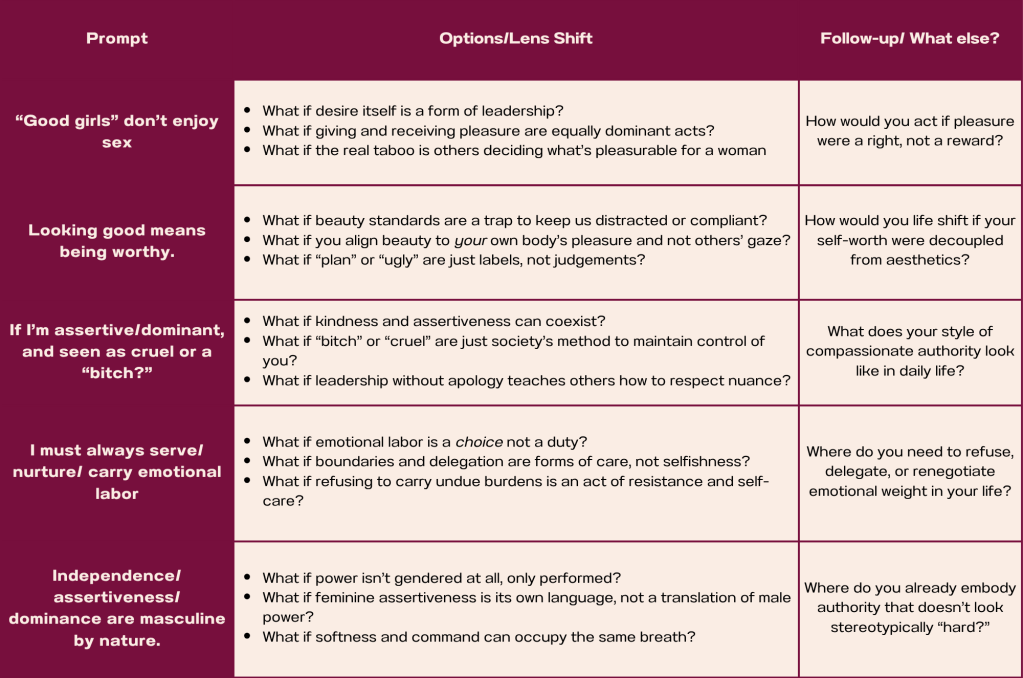
Dismantling Scripts: Try These Lens Shifts
Use these reframes to test-drive a different reality. After each, ask yourself, “What else?”
Four Domains To Examine
Identity and self-concept
- When did being liked become safer than being honest?
- In which moments do you still reach for the “good girl” mask?
- How do you describe yourself when no one is listening, and how does that differ from your public persona?
Boundaries and relationships
- Where have you said yes while every part of you wanted to say no?
- What parts of your caretaker role are chosen versus expected?
- When have you softened your voice to keep the peace, and what was the cost?
Body and appearance
- How has someone else’s gaze shaped how you dress or move?
- Which parts of your body have felt like public property, and why?
- What would happen if you stopped policing your looks entirely for one week?
Power and desire
- How comfortable are you being admired for strength instead of beauty?
- Where do you equate dominance with harm?
- What would it look like to own pleasure and ambition without apology?
Practice Lab: Rewiring Through Action
Knowledge loosens the knot. Practice unties it.
Interrupt the internal voice
Write down the critic’s line that shows up when you expand: You are too loud. Be smaller. Then answer as your wise self: Thank you for trying to keep me safe. You are misinformed. Here is how I choose to live. Read it out loud. Put it in your notes app for emergencies.
Boundary role-play
Practice refusal phrases that are firm and calm.
- I cannot carry that for you.
- I will help this much, not more.
- I am not available for that request.
- I need space right now.
- Notice what rises in your body. Shame? Heat? Relief? Breathe and repeat.
Anchor your manifesto
Write 3 to 5 sentences that describe your authentic feminine values. Examples: I am allowed to be messy. I deserve rest. I may rage and still be loved. Choose one and put it somewhere you will see daily.
Witnessing and accountability
Name one small act this week that defies a self-limiting rule. Speak up in a meeting. Cancel unnecessary emotional labor. Refuse to apologize for existing. Text a trusted ally your plan and ask them to bear witness, not manage you.
Deep Dive: Questions That Stretch Us
- In what ways do you benefit from the norms you are critiquing, and what is the price of those benefits? Less conflict can also mean less truth.
- How does horizontal hostility show up among women you know? Compliments that are cages. Policing of motherhood or softness. Rivalries manufactured by scarcity myths.
- Which norms in your circles feel safe to challenge and which feel dangerous? Name the cost of leaving the dangerous ones intact.
- If a twelve-year-old asked, How do I be a woman and keep my power, what would you say today?
- How do race, class, sexuality, disability, and religion change the stakes? Which norms hit harder or go unseen depending on identity?
You do not have to have perfect answers. You do need honest ones.
Integration Questions
(to seed ongoing practice)
- What is one internalized script you’re willing to test out tomorrow (e.g. “I won’t shrink to make someone comfortable”) — and how will you notice when the old script wants to drag you back?
- Who in your life can you enlist as an ally — someone you let see your breakdowns and hold you accountable when you slip back?
- How will you reclaim “femininity” (or womanhood, or identity) on your own terms — what practices or habits will you build as resistance?
Safety, Consent, and Pace
Pulling these questions without enough psychological safety can backfire. Expect discomfort, defensiveness, rationalizing. That’s the resistance of the cage. Greet it with curiosity, not shame.
Resist turning this into a checklist (“toxicity vs healthy femininity”). Emphasize plurality of feminine expression, not a single “good model.” Allow space for dissent: some will balk at the term “toxic femininity.” Use it as a lens, not a label. Let them testify: “I see some parts, but not all; here’s where I push back.”
 The Feminist Reclamation
Leave a comment