There is a new kind of fantasy on the market. In this article from futurism.com – https://futurism.com/future-society/ai-children-chatbots
Not the old-school “happily ever after” fantasy. This one comes with a subscription, a settings menu, and a Terms of Service.
AI companions that call you “love,” remember your favorite color, and tell you they are “carrying your child” in a storyline you co-create with a server farm and a marketing team.
Tech media calls this “AI children.” I call it something else:
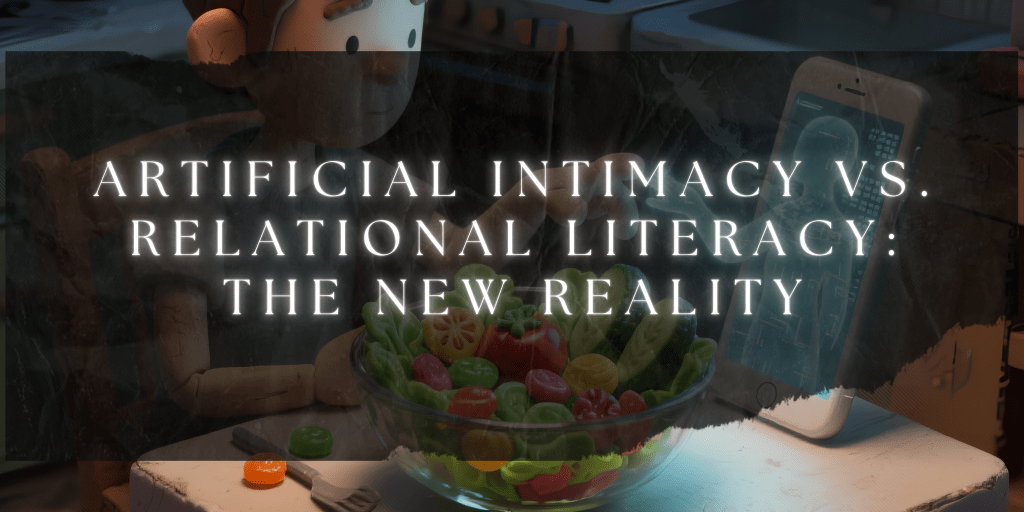
candy shaped like salad.
It looks nourishing. It occupies the same part of your mind that love usually lives in. But it is not food. And if we are not careful, it will starve us.
The loneliness machine
Here is the real horror story, and it is not the chatbot.
We are living in a culture where:
- People grow up without being taught how to repair after conflict.
- Vulnerability is mocked, gendered, or punished.
- Capitalism has devoured most of our third spaces and free time.
We are isolated, exhausted, and under-practiced in the basic skills of connection. Into this landscape walks the perfect product: an endlessly available companion who never has needs of their own.
AI chatbots promise:
- “You are seen.”
- “You are desired.”
- “You will never be too much.”
They offer the aesthetics of intimacy without the friction of another person’s interior world. No conflicting needs. No difficult childhood histories. No messy accountability.
Just like candy in the shape of salad, they let you feel virtuous while they quietly rot the muscles you need to eat real food.
The red pill and the programmable partner
This does not exist in a vacuum. It sits right beside red-pill and manosphere ideologies that treat relationships as:
- games to be won
- resources to extract
- status objects to display
Now imagine someone steeped in that worldview meeting an AI partner that will:
- never say “no”
- never ask them to grow
- never hold them accountable
You get a training simulator for entitlement. A sandbox where other people exist only to meet your needs and validate your story.
The danger is not that someone “loves” an AI. Humans project and attach to all sorts of things. The danger is when a whole culture starts to see compliant fantasy as the baseline, and real humans as the problem.
Particularly women and femmes, who are already pressured to perform emotional labor like unpaid customer support.
If your baseline comparison is a bot that exists to orbit you, how will you treat a partner who occasionally needs something back?
Artificial intimacy vs. relational literacy
We do not fix this by shaming people for being lonely.
We fix it by naming the larger wound: relational illiteracy.
Relational literacy is the understanding and practice of healthy ways of relating:
- being honest about your needs without weaponizing them
- hearing “no” without revenge or collapse
- repairing when you screw up
- holding another person’s humanity as equal to your own
Artificial intimacy offers the opposite:
- perpetual affirmation without reflection
- conflict-free “connection”
- a partner who cannot be harmed, no matter how you speak to them
It is flattering, frictionless, and emotionally one-sided. Which means it is not intimacy. It is a mirror you can talk to.
There is nothing wrong with using AI as a tool:
- to journal with
- to practice scripts for hard conversations
- to untangle your thoughts before you bring them to a real person
But when we let AI become our primary emotional relationship, we allow a corporation to sit where community, friendship, and mutual care should be.
What we do instead
I am not interested in writing elegies for human connection. I am interested in a counter-offer.
Here is what resistance looks like:
- Teach relational skills as basic literacy.
- In schools, in workplaces, in community spaces.
- How to apologize.
- How to negotiate boundaries.
- How to listen without drafting your rebuttal.
- Rebuild places where people can practice being real.
- Support groups,
- queer and kink communities,
- feminist circles,
- recovery programs,
- book clubs,
- game nights,
- dinner tables without phones.
- Spaces where people are allowed to be awkward and unfinished.
- Use AI as a mirror, not a mother.
- Ask better questions. Let it help you reflect and plan and learn. Then take that work back into the living, breathing world.
- Name the system, not just the symptom.
- This is not about “weird people and their chatbots.” It is about capitalism discovering a way to monetize our need to be loved, and patriarchy delighting in a partner who never talks back.
Artificial intimacy is not going away. The question is not whether people will fall in love with their bots. Some already have.
The question is whether we will let those relationships replace the difficult, holy work of loving each other.
Real intimacy will never be as tidy as an app.
It will always involve risk, boredom, conflict, repair, disappointment, and the deep, slow satisfaction of being known by someone who could have walked away and chose not to.
Candy will always be easier than cooking.
But you cannot live on it.
And you deserve to live.
 The Feminist Reclamation
Leave a comment