
(And Who’s Paying for It)
The Invisible, Unpaid, Unacknowledged Work That Subsidizes Everything
You remembered his mother’s birthday. You noticed the toilet paper was running low before anyone else did. You de-escalated the tension at Thanksgiving dinner with a well-timed subject change. You drafted the text your friend needed to send her landlord. You held space for his bad day at work while swallowing your own. You did all of this today. Nobody noticed. Nobody was supposed to.
Sociologist Arlie Russell Hochschild coined the term “emotional labor” in 1983 to describe something specific: the management of feelings as a job requirement, sold for a wage. Hochschild study identified this emotional labor in the workplace, but it’s just the tip of an iceberg that extends deep into every kitchen, every relationship, every family group text, and every office where a woman is expected to be the one who “keeps the peace.”
The cost of this work is not metaphorical, it’s measurable in hours, in dollars, in mental health outcomes, in careers derailed and ambitions deferred. And the beneficiaries, the people and systems that profit from women’s unpaid emotional management, have a vested interest in making sure it stays invisible.
It is time to make it visible. It is time to send the invoice.
I. Let’s Get the Definition Right
The first thing to understand about emotional labor is that it has been systematically misnamed in popular discourse, and that misnaming serves a purpose.
When Hochschild published “The Managed Heart: Commercialization of Human Feeling” in 1983, she drew a sharp distinction between “emotional labor” (emotion management performed for a wage, as a condition of employment) and “emotion work,” which is the unpaid emotional management we do in private life. The flight attendant producing calm in a cabin full of anxious passengers is performing emotional labor. The wife producing calm in a living room full of her husband’s anxious family is performing emotion work. Both require the same skills, and yet only one comes with a paycheck.
This distinction matters, because the popular collapse of these two concepts into a single buzzword, “emotional labor,” has actually made it easier to dismiss. When everything from “my partner doesn’t do dishes” to “I had a hard conversation at work” gets labeled emotional labor, the term loses analytical power. It becomes something people roll their eyes at. And that is precisely what patriarchal systems want: for the language of women’s exploitation to be vague enough to be ignorable.
For the purposes of this post, we are talking about the full spectrum: the commercialized emotional labor Hochschild identified, the private emotion work she distinguished from it, and the cognitive dimension of domestic labor, what researchers now call “the mental load,” that encompasses planning, anticipating, delegating, monitoring, and worrying about the needs of everyone in a household. Journalist Gemma Hartley, whose 2017 Harper’s Bazaar piece “Women Aren’t Nags—We’re Just Fed Up” was shared by millions of readers, described it as “emotion management and life management combined.” That combined category is what women are actually living. And it is that combined category, not the sanitized, diluted version, that demands our attention.
II. The Inventory: What Women Actually Carry
To understand the cost, you first have to see the work.
She remembers the dentist appointments. She tracks who needs new shoes, who’s outgrown their coat, who has a field trip permission slip due Friday. She knows which friend of her child is going through a hard time at home and adjusts playdates accordingly. She manages the grocery list, the meal plan, the dietary restrictions of every guest who might come to dinner. She notices when the soap dispenser is empty, when the filter needs changing, when the dog is due for a vet visit. She signs the forms, files the taxes, updates the insurance. She is the memory of the household. She is its secretary, its diplomat, its project manager, and its therapist, and she holds no title for any of it.
At work, she moderates her tone so she won’t be perceived as aggressive. She softens her emails with exclamation points she doesn’t feel. She organizes the office birthday cards, plans the baby showers, and mediates tensions between colleagues who will never know she did it. She is the first person asked to take notes in a meeting and the last person credited for the idea she raised in one.
In relationships, she initiates the difficult conversations. She tracks the emotional temperature of the household. She notices when he’s withdrawn and coaxes the conversation. She translates her needs into language he can hear without feeling criticized. She performs the exhausting cognitive work of managing not just her own emotions, but his response to hers.
In friendships, she’s the one who checks in. She’s the one who plans the gatherings. She’s the one who remembers the anniversary of a loss and sends the text that says, “Thinking of you today.”
None of this appears on a time sheet. None of it generates a performance review. But remove it—all of it, all at once—and every system it quietly sustains would collapse within a week.
III. The Receipts: What the Data Says
The empirical evidence is unambiguous.
According to the United Nations, women globally perform three-quarters of all unpaid care and domestic work, the equivalent of 11 billion hours every single day. On average, women spend 2.5 times more hours daily on unpaid care work than men. UN data projects that even by 2050, women will still be spending more than two additional hours per day on unpaid domestic and care labor compared to men if current trends hold.
In the United States, the Gender Equity Policy Institute found that women aged 18 to 24 already perform roughly twice the household work of men their age, eight hours per week compared to 3.8. By the time they reach the prime working and childrearing years of 25 to 34, women do 2.3 times as much household work and 2.8 times as much childcare as men. Even among adults with no children in the home, women do twice as much household work as men. Among mid-life women aged 45 to 54 without children at home, the ratio climbs to 2.7 times.
And these numbers capture only the physical tasks. A 2023 study published in the journal Sex Roles, A Journal of Research, found that the cognitive dimension of household labor, planning, anticipating needs, delegating, monitoring, was even more gendered than physical tasks. The researchers found that within households of mothers with young children, women’s share of cognitive labor was more disproportionate than their share of physical housework. This cognitive labor was significantly associated with women’s depression, stress, burnout, overall mental health deterioration, and relationship dysfunction. A systematic review published in The Lancet Public Health confirmed the pattern: among employed adults, unpaid labor is negatively associated with women’s mental health, with effects far less apparent for men.
Arlie Hochschild’s original research for The Second Shift (1989) found that women in dual-income households worked an extra fifteen hours per week compared to their husbands, the equivalent of an additional 24 days each year. She wrote that these women talked about sleep the way a hungry person talks about food. More than three decades later, UN Women confirms the pattern remains globally entrenched: 45 percent of working-age women are excluded from the labor market entirely because of unpaid care responsibilities, compared to just 5 percent of men.
Hochschild also identified something critical: approximately one-third of American men’s jobs and fully one-half of American women’s jobs required substantial emotional labor. Women are not only doing more unpaid emotion work at home. They are disproportionately concentrated in the paid jobs that demand it, and those jobs are systematically undervalued and underpaid precisely because the skills they require are coded as feminine.
IV. Who Benefits: The Political Economy of Women’s Exhaustion
The question is not just who does the work, it’s who profits from the work being unpaid.
Patriarchal capitalism requires a permanent underclass of free labor to function. That underclass is largely women. The entire structure of the modern economy, from the length of the workday to the design of the school calendar to the assumption that someone is always available to manage a sick child, is built on the premise that an invisible person (a woman) is absorbing the costs that the market refuses to pay.
This is not incidental. It is architectural. As feminist economists have argued for decades, the reason care work is unpaid is not that it lacks economic value, it is the foundation upon which all other economic activity rests, but that paying for it would require a fundamental redistribution of resources away from the people and institutions that currently benefit from getting it for free.
The corporate workplace benefits when a female employee manages office morale without a title or raise. The heterosexual marriage benefits when a wife manages the social calendar, the extended family relationships, the household logistics, and the emotional climate of the home without complaint. The school system benefits when a mother tracks homework, permission slips, and teacher conferences that the institution itself fails to communicate clearly. The healthcare system benefits when women serve as unpaid coordinators of elderly parent care, navigating insurance bureaucracies and managing medication schedules that would otherwise require paid case managers.
In every case, the beneficiary is not the woman, the beneficiary is the system that extracts her labor and returns to her exhaustion, anxiety, depression, and the quiet, corrosive knowledge that what she does all day is both essential and, in the eyes of the world, nothing.
Sociologist Arlie Hochschild was precise about this: when emotional labor is commodified, when feelings become a product sold for a wage, the worker risks alienation from her own emotional life. Flight attendants she interviewed described their smiles as being on them but not of them. But what happens when the same dynamic operates without even the dignity of a paycheck? When the emotion management is extracted not by an employer but by a culture, a family structure, an entire civilization? The alienation goes deeper; it becomes identity. Women begin to believe that the exhaustion is a personal failing rather than a structural extraction.
V. The Conditioning: How Women Are Trained to Carry the Load
The gendered distribution of emotional labor is not a product of biology. It is a product of training, training that begins in childhood and is reinforced at every stage of life by every institution women encounter.
Girls are socialized to attune to others’ emotions from the earliest age. They are praised for being “helpful,” “sweet,” and “considerate”—adjectives that describe emotional labor performed for free. Boys are praised for being “strong,” “brave,” and “independent”—adjectives that describe the freedom from emotional labor. By the time they reach adulthood, women have internalized the expectation so thoroughly that many cannot distinguish between who they are and what they do for others. The labor feels like identity; refusing it feels like selfishness.
This conditioning is reinforced by the cultural punishment women receive when they stop performing. A woman who does not remember birthdays is “cold.” A woman who does not smooth over conflict is “difficult.” A woman who does not manage her partner’s feelings is “unsupportive.” A woman who asks for equal distribution of domestic cognitive labor is “nagging.” The vocabulary of feminine failure is, in every case, a description of emotional labor withheld. Women are not punished for what they do wrong, they are punished for what they stop doing for free.
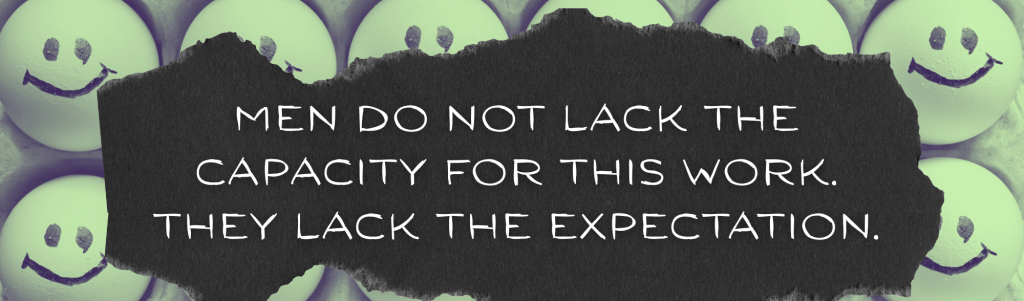
Research confirms what feminist scholars have long argued: the gender gap in mental labor is not rooted in cognitive differences between men and women but in gendered differences in motivation that stem from stereotypes and social expectations. Men do not lack the capacity for this work. They lack the expectation. And because communal, care-oriented roles are culturally coded as feminine, men who take them on often experience what researchers call “gender role conflict”—a discomfort that functions as a social enforcement mechanism, pulling them back from equitable participation. The result is a self-reinforcing cycle: women carry more because they are expected to, men carry less because they are permitted to, and the gap reproduces itself generation after generation.
VI. Liberation: What Refusal Looks Like
Liberation from emotional labor exploitation does not begin with doing less. It begins with seeing clearly what you have been doing and deciding, with full consciousness, what you are willing to continue.
It begins with naming. Every act of anticipation, every smoothed conflict, every remembered appointment, every modulated tone is labor. Calling it love does not make it free. Love is a feeling; labor is an action performed in the service of others that consumes time, energy, and cognitive resources. Women can perform both simultaneously, but only one should come with the expectation of reciprocity.
It continues with refusal, not the dramatic, cinematic refusal of throwing dishes on the floor, but the quiet, deliberate refusal to carry what is not yours. The refusal to remind him about his own mother’s birthday. The refusal to preemptively manage his emotional reaction to a conversation you haven’t had yet. The refusal to apologize for being direct. The refusal to perform gratitude for tasks that should never have been yours alone.
Stop saying you’re sorry for everything, especially things you have zero control over. Stopping this trauma-response cold-turkey is difficult, so start by replacing “sorry” with “apologies.” One denotes a personal failing, the other an unfortunate event. After this subtle shift you’ll be more aware of how often you apologize, and for what, so you can next simply stop making apologize at all, unless they are truly necessary.
Sometimes breaking free from these behaviors requires solidarity. The individual woman who drops the emotional labor in her household will face backlash, from her partner, her family, her own internalized conditioning. She needs the collective, she needs other women naming the same work, refusing the same extractions, building the same language. This is what feminist reclamation means: not the recovery of a single word, but the recovery of women’s time, energy, health, and selfhood from systems that treat them as inexhaustible natural resources.
The real cost of emotional labor is not that it is hard. It is that it is stolen. Stolen time. Stolen energy. Stolen years of cognitive capacity redirected from what women might have built, created, pursued, or simply enjoyed if they had not been assigned, from birth, the role of making everyone else comfortable.
The bill is overdue. And we are done extending credit.
Works Cited & Further Reading
Hochschild, Arlie Russell. The Managed Heart: Commercialization of Human Feeling. University of California Press, 1983.
Hochschild, Arlie Russell, and Anne Machung. The Second Shift: Working Families and the Revolution at Home. Avon Books, 1989.
Hartley, Gemma. Fed Up: Emotional Labor, Women, and the Way Forward. HarperOne, 2018.
Daminger, Allison. “The Cognitive Dimension of Household Labor.” American Sociological Review 84, no. 4 (2019): 609–633.
Ervin, Jennifer, et al. “Gender Differences in the Association Between Unpaid Labour and Mental Health in Employed Adults: A Systematic Review.” The Lancet Public Health 7, no. 9 (2022): e775–e786.
Seedat, Soraya, and Marta Rondon. “Women’s Wellbeing and the Burden of Unpaid Work.” The BMJ 374 (2021): n1972.
Ciciolla, Lucia, and Suniya S. Luthar. “Cognitive Household Labor: Gender Disparities and Consequences for Maternal Mental Health and Wellbeing.” Sex Roles 89 (2023): 1–19.
Gender Equity Policy Institute. “The Free-Time Gender Gap.” GEPI, 2025.
UN Women. “Forecasting Time Spent in Unpaid Care and Domestic Work.” UN Women Data Hub, 2023.
Reich-Stiebert, Natalia, et al. “Gendered Mental Labor: A Systematic Literature Review.” Sex Roles 88 (2023): 444–463.
Steinberg, Ronnie J., and Deborah M. Figart. “Emotional Labor Since The Managed Heart.” Annals of the AAPSS 561 (1999): 8–26.
© 2026 Feminist Reclamation • feministreclamation.com
 The Feminist Reclamation
Leave a comment